

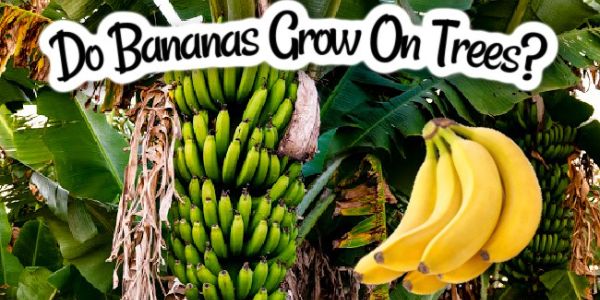
A Banana is not classified as a tree because it lacks a woody stem. Bananas are considered because thick fleshy succulent that functions as the stem. Bananas do not produce mature seeds that can enhance propagation through seeds. Wild bananas produce seeds that can germinate. The most common type of wild bananas whose seeds can germinate are, Musa acuminata and Musa balbisiana.
Bananas reproduce through suckers. Suckers originate from an underground stem called a rhizome. As the mother plant grows, the rhizome elongates forming new suckers attached to the base of the main plant. One banana stem can only produce suckers once before it produces fruits. Upon fruition, the fleshy succulent stem dies to the ground and the new suckers emerge to take up its space and produce other suckers. Suckers are also known as pups.
At a height of four feet, suckers can be separated from the mother plant and planted on their own. Separating suckers from the mother plant reduces competition for water and nutrients and also speeds up maturity.
Bananas that are closely related to wild type can be propagated through seeds. You need to soak the seeds in cold water for at least one day to break the seed dormancy. Once you have broken seed dormancy, you can plant your seeds in moist well aerated soil. After two weeks the seeds will germinate.
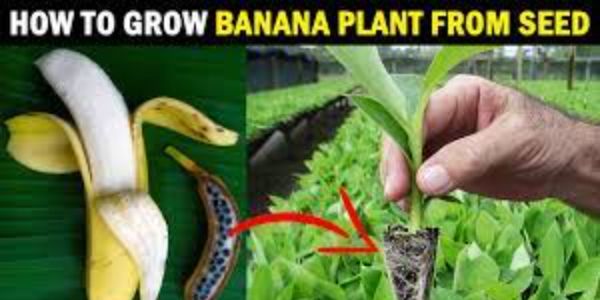
Bananas propagated through suckers are susceptible to disease due to the longer time they require to develop disease resistance. However, using suckers is a faster propagation method than seed.
Rhizomes that have eyes can be chopped and planted. Chopped rhizomes will grow though they take longer than suckers.
You can grow your bananas in rows at an interval of two-three meters apart to give room for the emergence of multiple healthy suckers. Bananas need regular check-ups to ensure that pests do not encroach on them. Pruning should also be done to ensure a less dense leaf network.
The procedure of planting bananas
- Cut the sucker from the mother plants with a hoe, shovel, or fork garden hoe. Ensure that roots are well removed.
- Transfer the sucker into the already prepared hole. Ensure the roots are fully covered with soil.
- If you are planting rhizomes, place the rhizomes one to two feet deep, shoots will emerge after some time.
Bananas will start producing flowers after six-eight months from planting time. The duration may vary depending on the prevailing condition. During flowering, you need to spray your bananas with insecticides and pesticides to keep off insects and pests that may invade the fruits.
At the flowering stage, the banana bunch needs to be supported with support material to avoid breaking down the stem due to heavy weight. Closely observe your fruits until they become well-rounded and flowers at the tips peel off easily. Consider harvesting your fruits when they are almost turning brown.
Conditions favorable for banana growing
- Humid tropical region.
- Temperature between 25 degrees Celsius to 30 degrees Celsius.
- A soil Ph of between 5.5-6.5
- Rich fertile well-drained soil with high nitrogen concentration.
- Wind protection. Bananas are prone to attack by the wind.
- Water should be available throughout the planting season. Bananas can rarely survive dry periods.
Where are bananas from?
The source of bananas is traced to Archipelago, Malaysia. Bananas are also believed to have early existence in India and the Philippines. Wild bananas still exist in considerable numbers in these places.