

DNA, Deoxyribonucleic Acid is the carrier of genetic information required for an organism’s growth and development. It is composed of two polynucleotide chains that twist around each other forming a double helix. DNA of plants and animals is made up of four base pairs, adenine (A), thymine (T), cytosine (C), and guanine (G).
The bases code for amino acids which are protein building blocks. This makes plants and animals have similar genetic orientations. This leads to little or no variation in the behavior of all living organisms.
What Are Genes, Genome, And DNA?
DNA is a molecule found in cells that carries genetic information and is made up of building blocks (amino acids)
Genes are a subset of DNA that determines which protein to make. Genes direct the functioning of the organism’s cells as well as the traits of an organism. Gene only forms two percent of a person’s DNA.
A genome refers to a complete set of DNA that is all genetic materials making up an organism, DNA or RNA, genes, and control elements.
The Similarity Between Human And Bananas
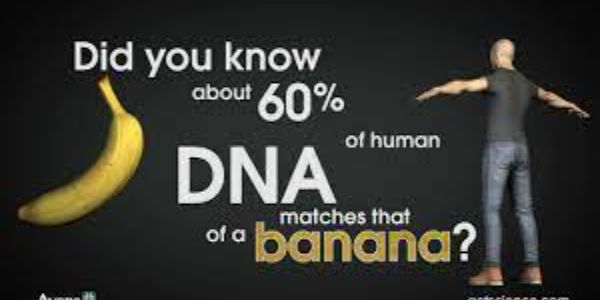
It is only 1.2 percent of DNA that is shared between human beings and bananas. However, it is worth noting that human DNA is about 60 percent similar to bananas. This is according to a blast search that was done by a scientist at National Human Genome Research Institute led by Brody.
The study established that bananas and humans share about 60 percent of genes that control basic functions resulting in the similarity. It is reported that researchers first screened banana genes to identify the genomic sequence in the typical banana genome.
“We then used these DNA sequences to predict the amino acid sequence of all the proteins that would be made from those genes.” Said Brody, the lead scientist. It was noted that the protein sequences were then placed in a file. A similar process was carried out in all human genes.
Consequently, the protein sequence from the banana gene is compared to the human gene. The program was to compare how similar the banana genes are to each human gene. The similarity percentage was expected to range between 0-100. Through this program, more similar matches were preserved than one would expect by chance.
Over 4 million comparisons were conducted, culminating in 7000 best runs. After that, the percentage similarity score of each run was averaged. This gave the result of 40 percent.
This is the average similarity between proteins, not genes. There are many genes in our genome that do not have identifiable counterparts in the bananas and vice versa.
All living things are related
You should not be worried about the striking similarity between bananas and human beings. The two seem distantly related but are indeed too close genetic-wise. Not only bananas and humans but all living creatures on earth have a manual of instruction called genome that makes it easy to trace all creatures to one source of origin.
Research shows that all organisms can be traced to have originated from a single-cell ancestor about 4 billion years ago. The supposed parent organism is said to be the last universal ancestor. As different species evolved from this common ancestor, several genetic sequences were transferred and preserved.
The discovery sheds light on why bananas are related to human beings and also justifies evolution theory to an extent.