

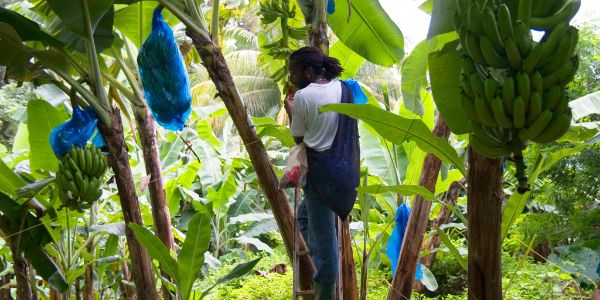
Here is a brief History of Bananas exploring their origins and how they grew to become one of the most beloved fruits.
Where Did Bananas Come From?
The origin of bananas has been pinned to Kuk Valley, New Guinea. Archeologists have narrowed down banana domestication to have started in 8000 BCE (Before Common Era). Musa acuminata and Musa balbisiana are the first species to be domesticated. From New Guinea, the domesticated species spread to the Philippines.
From New Guinea and the Philippines, bananas continued to spread to other tropical regions. It is estimated that bananas arrive in India, Malaysia, Australia, and Indonesia in the first two millennia since domestication. Plantain is thought to have been available in Eastern Africa by 3000 BCE and in Madagascar by the year 1000 BCE.
Arab conquerors introduced bananas to the west in 327B.C. Bananas are recorded in Buddhist literature to have existed in 600 BCE. In his expeditions to India in 327 BC, Alexander the Great came across bananas. It is believed that bananas were introduced to South America by sailors of South East Asian origin. By the 3rd century CE, plantains were being cultivated in China on large scale.
Bananas were rediscovered and redistributed for the second time around the Indian Ocean world carried by the Muslim wave. Noted down in the 11th century BCE Islamic literature, bananas were an item of trade for Muslim merchants in trade routes of South East Asia and the Middle East. It is reported that Muslims carried bananas from East Africa to West Africa. Bananas arrived in North Africa and Moorish- controlled Spain in the 1200s.
A third wave of banana emergence occurred in Asia and Europe. It is predicted that bananas were brought to Europe during the Moorish invasion by the 13th century. Japanese used banana fibers to make clothes. They grew a specific variety of bananas for making clothes. In the early modern world, bananas were only grown on a small scale. Large-scale production of bananas started in 1834 and exponentially increased towards 1880.
North Americans started to eat bananas after the civil war. The bananas were sold at very high prices which made it hard for many people to afford them. In 1880, bananas became widely available to the people and there was a lag in price.
The earliest modern plantations were erected in Jamaica and the nearby Caribbean zone. It involved modernized storage facilities, transport, and production techniques. Large-scale banana trade resulted in rich multinational companies that wielded deep international influence. The companies enjoyed monopoly power.
It is the operations of these companies that gave birth to the commonly used political phrase Banana Republic. Political elites used the companies to maneuver over their rivals and have a say in international matters, especially during the cold war.
Banana Diseases
The first disease to attack bananas was a mold called Fusarium. Fusarium was also referred to as Panama disease and it was found in the soil. The second disease to attack bananas was a fungus known as Sigatosa. Sigatosa is an air-bone fungus.
Researchers realized that they could spray bananas with a pesticide called Bordeaux Mixture which successfully contained Sigatosa. Crop rotation was the method deployed to control Fusarium. Later on, a new species that is resistant to Fusarium was discovered. Disease resistant species is known as Giant Cavendish. Cavendish is the most widely cultivated species in the current world.